Yes, Exercise Is Physical Activity, But Not All Physical Activity Is Exercise
Last modified 6 months, 2 weeks ago.
High-intensity training (HIT) proponents have a useful model for categorizing the activities that are used to maintain or improve one’s fitness.
A person can engage in 1) exercise or 2) physical activity.
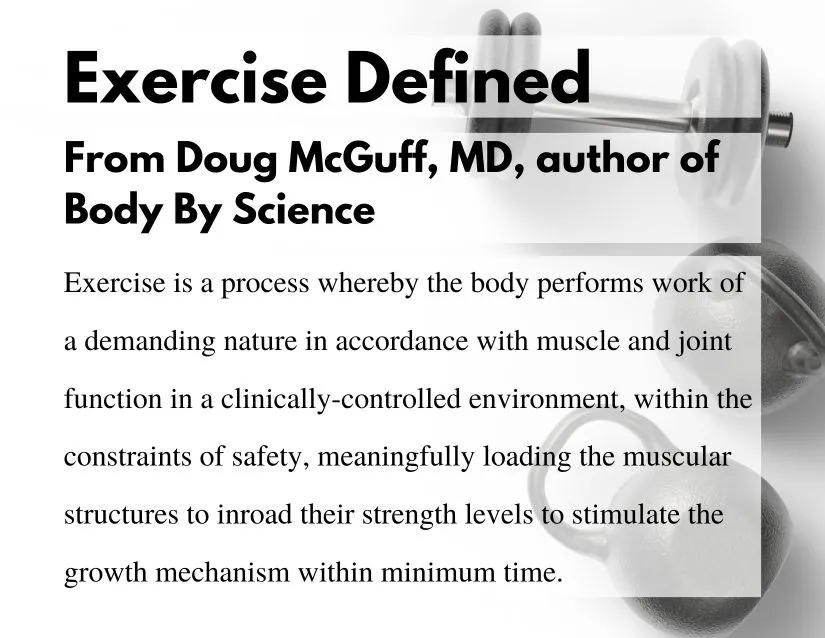
Exercise as defined by Dr. Doug McGuff, author of Body By Science:
“Is a process whereby the body performs work of a demanding nature in accordance with muscle and joint function in a clinically-controlled environment, within the constraints of safety, meaningfully loading the muscular structures to inroad their strength levels to stimulate the growth mechanism within minimum time.”
Proper mechanics. Minimal time. Sufficient resistance. Meaningful fatigue. (The environment may vary, though). Safety, too, which requires using control, not jumping, throwing, or exploding against the resistance to move it.
That’s proper exercise.
Physical activity is anything else people do to stay active, break a sweat, have fun, and just get up and moving. This includes bicycling, jump rope, walking, dance class, yoga, becoming an ultimate ninja warrior, most group-exercise classes, sports (like tennis or pickleball), whatever.
Take jump rope, for example.
Jump rope is not exercise. It’s physical activity.
That’s how it should be used, too. For athletes, it has some applications, but it is not a primary conditioning tool. For everyday people just looking to be healthy and fit, it’s something that can be done for fun and even to play. Dr. McGuff describes the active phenotype, which is where a person spontaneously wants to become more active and mobile, because of the fitness they’ve achieved with proper diet and exercise. Taking up jump rope a few days per week very well may be the expression of your active phenotype, or spontaneous desire to move more, because you’re healthy and fit.
But it is a common thinking error to overlook that exercise is physical activity, but not all physical activity is exercise.
Jump-rope training, courses, coaching, and products are presented and sold as exercise (remember our definition).
The benefits are extolled as an absolute boon, such as, burning 100-200 Calories in ten minutes, becoming fit and athletic, like a champion boxer, building muscle while losing fat, developing athletic coordination, and more.
The calorie burning is a misleading promise. At first, you will use more energy (calories), because you’re inefficient. But if you do get better at jumping rope (more skill, finesse, coordination), your body should use less calories per unit time than when you started, because you’ve become more efficient. Any rhythmic steady-state exercise is like that, such as running, cycling, and jump rope, too.
Don’t exercise to burn calories. Use it as a wellness tool and learn how to eat the right balanced diet for you.
As for building the fitness of champion boxers with the jump rope, that is grossly misleading. On a consultation call a few years ago, Dr. McGuff explained to me that a gifted athlete can go outside every day for eight weeks, dig a six-foot hole, fill it back in, and become fit.
I just let you in on a little secret of champion athletes...
Exceptional athletes can do just about anything for physical activity–with a meaningful effort, and get good results.
That’s why champion boxers, like Sugar Ray Leonard, Muhammad Ali, and George Foreman ran mile after mile, chopped wood, and of course, did a lot of jump rope, too.
Not that we cannot glean anything from champion athletes, but it takes a lot more nuance than just copying their fitness routines and habits. The average person is not going to respond nearly as well as a champion athlete does to chopping wood, running endless miles, or jump rope. Worse, the average person may end up injured for their efforts, given the pounding and abuse the joints take doing these activities under high velocities. (This includes swinging and snatching kettlebells–even with the best of form).
I love jump rope. I started when I was 15 years old, and intermittently jump rope to this day. It’s good fun. But it’s physical activity–not exercise.
Resistance training is exercise. That’s what needs to be the cornerstone of your fitness program.
If you’re not resistance training (lifting weights), then your fitness program will achieve far less than what it could.
Although you might only need 10 minutes to get a “jump-rope workout” done, in the long-run, you’ll have wasted a lot of time compared to what you could have achieved with a well-designed weight-training program.
In sum, do the physical activities that you like, because it’s your life. Enjoy it! But not all physical activity is exercise. You’re missing out if you never learn how to exercise properly.
It’s worth the effort.
Interested? Not sure where to start? Pick up a copy of Body By Science by Dr. McGuff. It’s also available on Internet Archive. Email me, if you have any questions about resistance training. Also, check out my blog series on HIT, too.